Processing a Northern Saw-whet Owl
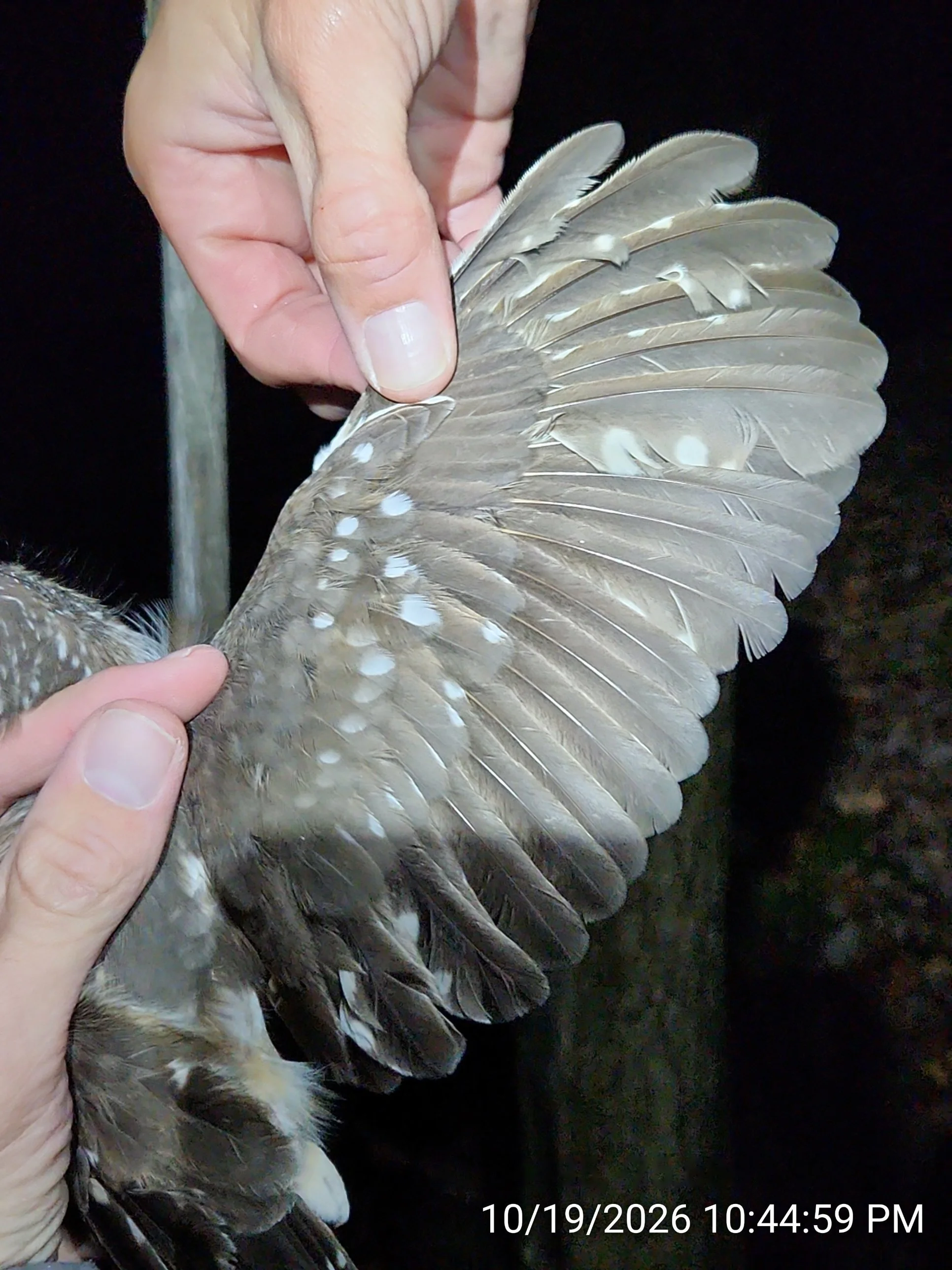
Aging a Northern Saw-whet Owl using visible light
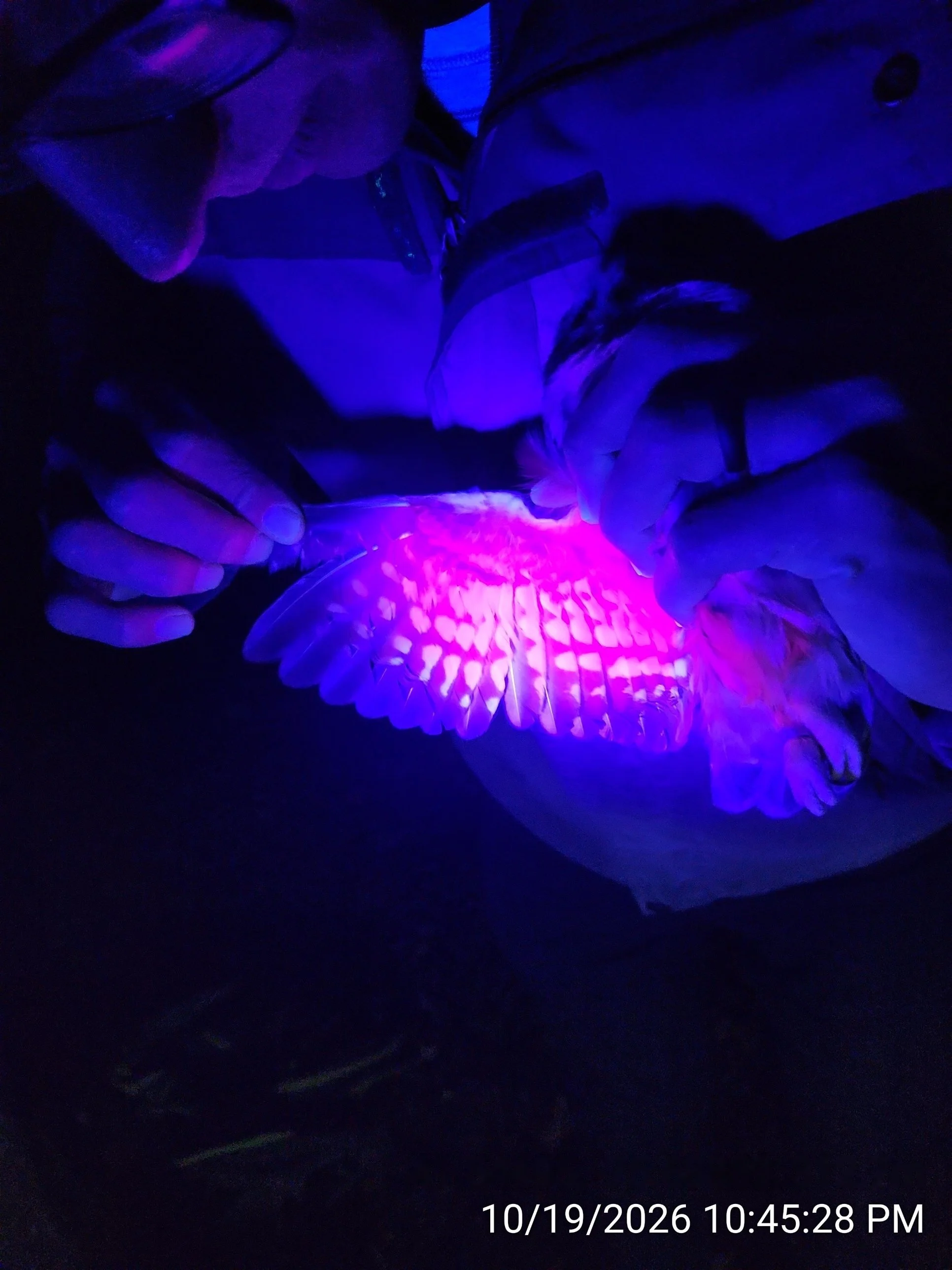
Aging a Northern Saw-whet Owl using UV light on the underside of the wing
(this is the same bird as the above)
How We Band Northern Saw-whet Owls
Capture
Each fall, Northern Saw-whet Owls migrate south through northeastern Pennsylvania. Because they are small, strictly nocturnal and almost silent outside the breeding season, they are rarely seen, even though many of them pass through our area. Banding gives us a way to count them, measure them and follow individuals over time.
We currently run two banding sites. At both, we follow the standardized protocols of Project Owlnet, a network of owl-migration researchers across North America that has promoted comparable netting, aging and sexing methods since 1994. Using the same methods as other stations means our data can be compared with, and contribute to, owl migration research across the continent.
We catch owls at night with mist nets. These are fine, nearly invisible mesh nets stretched between poles along openings in the woods. Near the nets we play a recording of the male saw-whet's repetitive "toot" advertising call. Migrating owls come in to investigate the sound and fly into the nets, where they settle into a fold of the mesh without harm.
We check the nets every 30 minutes throughout the night, so no owl stays in a net for long. Each owl is carefully removed by a trained bander. The net it came from and the time it was found are recorded, and the owl goes into a soft cloth bag, which keeps it calm and dark on the short walk to the banding station.
Processing an owl
At the banding station, each owl goes through the same sequence of steps, and a scriber records every result on our data sheet.
Banding
The bander first checks for an existing band. A previously banded owl may be a returning bird or one banded elsewhere. If the owl has no band, the bander applies a federal band, and the scriber records the band number. Every measurement and comment is linked to the bird by date and band number.
Mass
We weigh the owl in its bag, then weigh the empty bag, both to 0.1 g. The difference is the owl's weight. Body mass tells us about condition, and it is half of the sexing method.
Age
We age each owl by reading the history written in its wing feathers. Saw-whet owls don't replace all of their flight feathers at once. Instead, they molt a few each year, so an adult's wing holds a mix of feathers grown in different years. A young owl hatched this summer has a full set of feathers that all grew at the same time.
We start by spreading the wing under ordinary light. Older feathers tend to look more worn and faded than newer ones, which gives us a first impression of whether the wing holds one generation of feathers or several.
Then we look at the same wing under ultraviolet (black) light. Newly grown owl feathers contain natural pigments called porphyrins that glow bright pink under UV light. Those pigments break down with age and sunlight, so older feathers glow less, or hardly at all. Under UV, the different generations of feathers stand out clearly. A wing that glows evenly bright belongs to a young owl in its first fall, while a patchwork of bright and dull feathers marks an older bird. The pattern of that patchwork lets us estimate how many years old the owl is, using the age classes defined by Project Owlnet.
Wing, tail and bill measurements
Unflattened wing chord: the wing measured in its natural shape, without flattening. This is the measurement used for sexing, so it is taken first and never flattened.
Flat wing: the same wing gently flattened along the ruler.
Tail length.
Bill (culmen): measured twice in millimeters, once as total length and once from the nostril to the tip.
Sex
Male and female saw-whets look alike, so we determine sex from the wing-mass method developed by Project Owlnet. Owls weighing 93 g or more are female, owls weighing 78 g or less are male, and owls in between are assigned using a table that combines mass and unflattened wing length. Owls that can't be confidently assigned are recorded as unknown.
Body condition
Fat score (0–5): We gently part the feathers to check the wingpit. The score runs from no visible fat up to fat filling and spilling over the wingpit.
Muscle score (1–5): We feel the breast muscle on either side of the breastbone. The score runs from a sharp, sunken keel (starving) to muscle bulging past it.
Together these show how much energy the owl is carrying for its migration.Eye and face
Iris color: We match the iris against four standard paint-chip colors, from gold to bold yellow.
Face score: We rate how much white surrounds the eyes, from no ring to broad rings.
Photographs: We also photograph each owl's face, including close views of the eyes, using a flash and a color calibration card so colors can be compared fairly from photo to photo. We plan to analyze these pictures with computer software to measure iris color and facial patterns more precisely than the eye can judge, and to study how these features vary among individual owls.
Eye color is more than a single shade, so in our photos we describe each iris by three separate qualities:
Hue is the color itself, where the iris falls between a deep golden yellow and a pale lemon yellow.
Brightness is how light or dark the iris appears.
Intensity (also called saturation) is how vivid or rich the color is, from a strong, pure yellow to a softer, more muted one.
Two owls can share the same hue yet differ in brightness or intensity, so measuring all three gives a far more complete picture of each bird's eyes than a paint-chip match alone. With these measurements, we can ask whether eye color differs between males and females or young and older owls, and how much it varies from one individual to the next.
Notes
We record anything unusual, such as molt details, injuries, parasites, odd plumage or handling issues.
Release
Before release, we let each owl reacclimate to the dark. When the owl is ready, it flies away on its own.
When the owl is released, we record the release time and the bander's initials. The release time shows how long each bird was handled, which helps us keep handling as brief as possible.